BasicInventory vs a spreadsheet
Almost everybody starts stock control in Excel or Google Sheets, and for a while that is the correct decision. This page is about the point where it stops being one.
A spreadsheet is the most flexible tool most businesses own. It costs nothing extra, everyone can read it, and it can be reshaped in an afternoon. For a hundred references in one room, it is genuinely hard to beat, and swapping it for software you have to learn would be a bad trade.
What a spreadsheet cannot do is remember things on your behalf. It will hold an expiry date, but it will not stop the wrong pallet leaving. It will hold a quantity, but it cannot tell you who changed it, when, or why. Those gaps stay invisible until the day they cost money.
Keep the spreadsheet if…
- Your catalogue is small enough that you can hold it in your head.
- Nothing you store has a lot number or an expiry date.
- Stock lives in one place and nobody needs to know which shelf.
- You never have to explain a figure to anyone weeks later.
- The file is only ever open on one screen, by one person.
Five signs it has stopped coping
None of these are about the size of the business. They are about the shape of the work.
- 01
You are sorting by date to find what expires
The information is in the file, but acting on it depends on someone remembering to look. Expiry is the single most expensive thing to forget, and the loss is silent until stock is written off.
- 02
“Where is it?” is answered by walking
A location column filled with “shelf B”, “B” and “B-2 (top)” cannot be filtered, so the fastest way to find something is still to go and look.
- 03
A number looks wrong and there is nothing to read
The count says 40, the shelf says 31, and the file has no memory of the intervening six weeks. Without a history there is no way to tell theft from breakage from a typo.
- 04
You keep dated copies of the file
inventario_v3_final_ok.xlsx is a backup strategy that only works when you remember, and restoring it means losing everything since.
- 05
The formulas have become load-bearing
Someone inserts a row, a range silently stops covering it, and totals are wrong for a month before anyone notices.
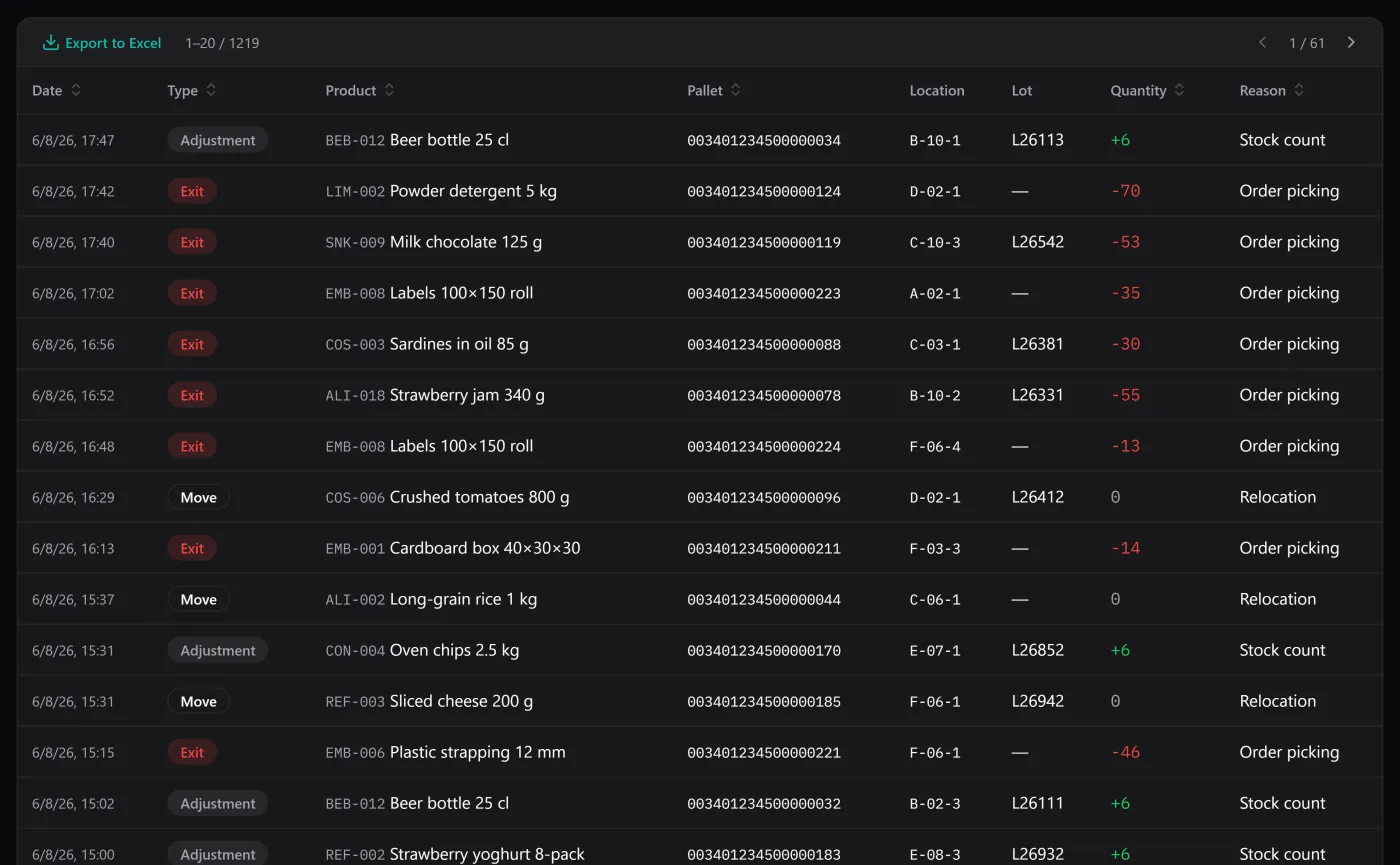
Side by side
| Spreadsheet | BasicInventory | |
|---|---|---|
| Where stock comes from | A number somebody typed over the previous one | The sum of entries, exits and adjustments actually recorded |
| Locations | Free text, spelled differently by each person | Aisle, column and height — one code, always filterable |
| Lots and expiry | Extra columns, remembered by hand | Required per product; one filter shows what is due, with lot and location |
| History | Whatever survived the last save | Every change dated, with reason, lot and location kept |
| Backups | Copies of the file, named by hope | One click, on close if you want, restored from inside the app |
| Reorder alerts | Conditional formatting somebody has to maintain | A reorder level per product, counted on the dashboard |
| Getting data out | It is already a spreadsheet | CSV export from every list, filters respected |
| Cost | Included with the office suite you already pay for | One payment, no subscription |
| Two people at once | Possible in a shared sheet — with the usual conflicts | Not supported: one computer, one person at a time |
What it costs to be wrong
A pallet of yoghurt written off because it sat behind a newer one. A customer order picked short because the file said units that were not there. An afternoon spent counting a warehouse to reconcile a number nobody can explain.
Any one of those costs more than a licence. That is the whole business case; there is not a bigger one, and a page that claimed otherwise would be lying.
Moving over
There is no import from Excel today — you type in your catalogue once, or start recording from the current count and let the history build from there.
Most people do it the second way: create the products and locations, register what is physically on the shelf as an opening entry, and never look at the spreadsheet again. A hundred references is an afternoon.
Nothing traps you afterwards: every list exports to CSV, and the database is a single file you can copy.
The honest verdict
If your stock has no dates, no lots and no locations worth naming, stay in the spreadsheet — it is free and it works. If any of those three matter, the spreadsheet is quietly costing you more than the €2.99 this does. And unlike most inventory tools, this is a one-time purchase, not a monthly subscription — so leaving the spreadsheet does not mean signing up for a bill that never stops.