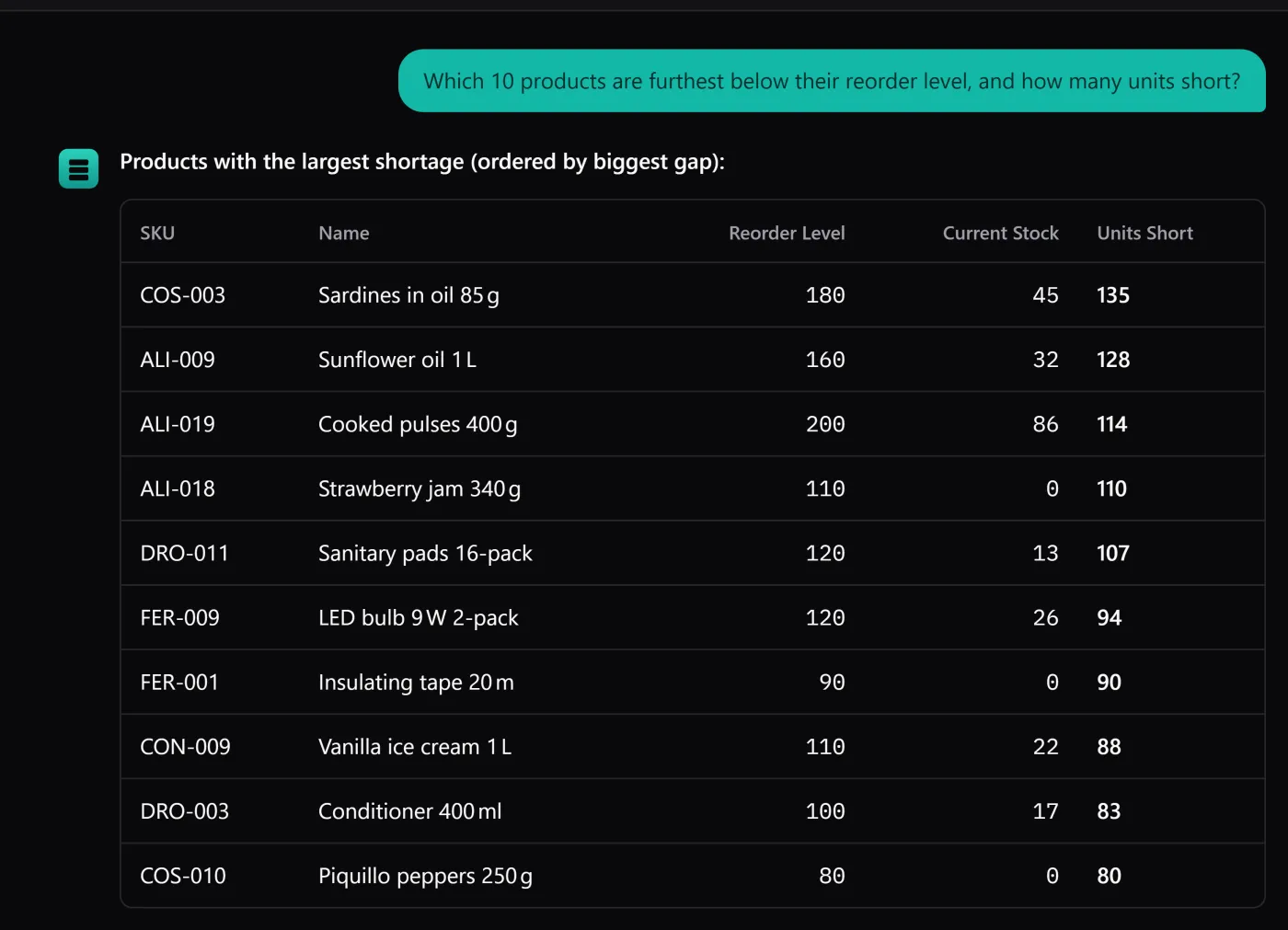
Most inventory software makes you learn where the answer lives. Which screen, which filter, which column to sort. Inventory software with an AI assistant flips that: you ask the question the way you’d ask a colleague — “which items are below their reorder level?”, “what expires this month?”, “how much of product X is in aisle A?” — and it answers from your own stock. That is the part no other application at around €19.99 offers, and it is the reason this piece exists.
It is also the least important reason to buy the app, which is why it ships switched off. Everything below is about being precise on what it is, because a feature you misunderstand is a feature that disappoints.
What “asks your stock” actually means
The assistant is a reading layer over the same database the rest of the application uses. When you type a question, it looks at the inventory rows needed to answer it and writes back a sentence. There is no separate data set, no sync, no “AI copy” of your warehouse that drifts out of date — it reads the live numbers, the same ones the stock movements and the dashboard show.
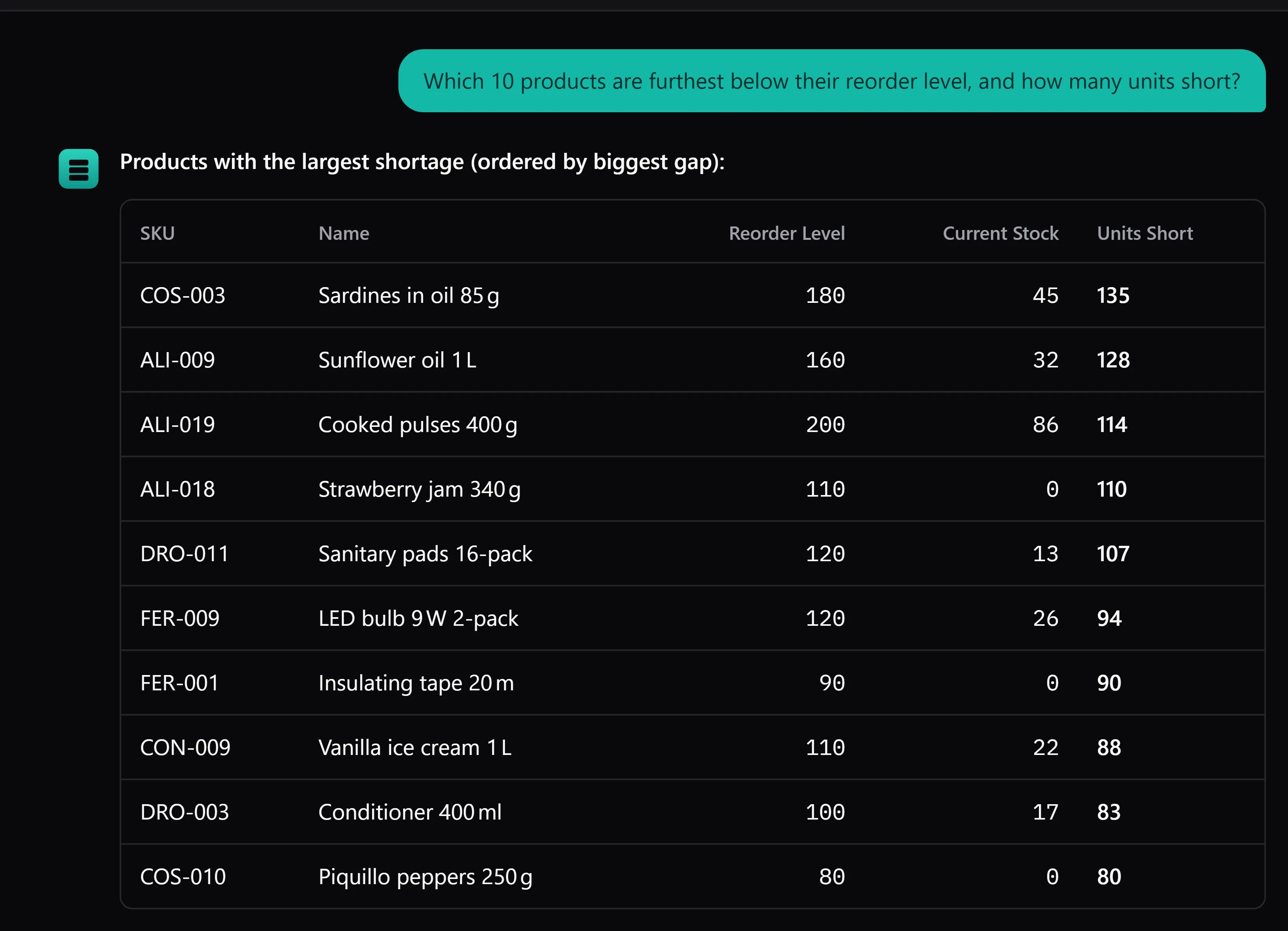
Ask in plain language; the answer comes from the live database, not a separate copy.
Because it reads structured data rather than guessing, the questions it is good at are the ones a warehouse actually asks all day: totals, what is low, what is near its date, where something sits. It is not a forecasting engine and it will not reorder for you — it answers, and you act.
It is optional, and it stays off until you say so
Out of the box the assistant is unconfigured. There is no account to create and nothing calling home. To turn it on you add a key from a provider you already have a relationship with: OpenAI, Anthropic, Google Gemini or OpenRouter. If you never add one, the assistant simply is not there, and the rest of the application keeps working offline exactly as before.
This is a deliberate design choice. The value of the app — locations, lots, movements, backups — does not depend on any cloud service. The assistant is a convenience bolted on top, and you opt in.
You bring your own key, so it costs cents on your own account
There is no subscription for the assistant and no markup. BasicInventory does not resell AI usage or take a cut: the question goes to the provider whose key you entered, billed to your account, under your agreement with them. In practice a question costs a fraction of a cent to a few cents depending on the provider and the size of your data — you are paying the model maker directly, not us.
That keeps the app honest with its one-time price. We are not renting you an AI feature every month; we gave you a door to a service you control, and you pay only for what you ask.
It can read, and only read
The single most important limit: the assistant cannot change anything. It queries your inventory to answer a question; it cannot create a product, edit a quantity, move a pallet or delete a line. A misunderstood question cannot cost you stock, because there is no path from the assistant to a write. The interface says so before your first message, and repeats under the input box that AI can get things wrong and answers are worth a glance before you trust them.
So the honest shape is: it saves you the walk to the right screen, not the judgement about what to do next.
Your key is encrypted, and a backup carries no credential
The provider key you enter is stored encrypted with AES-256-GCM, and the encryption key lives outside the database. That matters on the day you hand a backup to support or copy it to a new machine: the file carries your inventory, your settings and your licence, but not a usable copy of your AI credential.
What leaves your computer when you do ask a question is the question itself, the conversation so far, and the inventory rows needed to answer — nothing more, and only to the provider you chose. If that is more than you want to send anywhere, the answer is simple: don’t switch it on, and nothing does.
Is it a gimmick?
It would be, if it were the headline. It is not. The app is a proper stock system first — lots and expiry dates, a real location grid, an auditable movement history — and the assistant is the fastest way to interrogate all of that without learning the UI. For a small business owner who does not want to become a power user, “just ask it” is a genuine shortcut.
The best way to judge it is to use it. The live demo runs the whole application, assistant included, in your browser on a seeded warehouse — no key, no install, no account. Ask it something and see whether the answer is the one you’d have gone looking for.
When you’re ready, the price is a single payment that rises every five licences sold and never comes back down, so the copy you buy today stays yours for the 1.x line — assistant and all.